
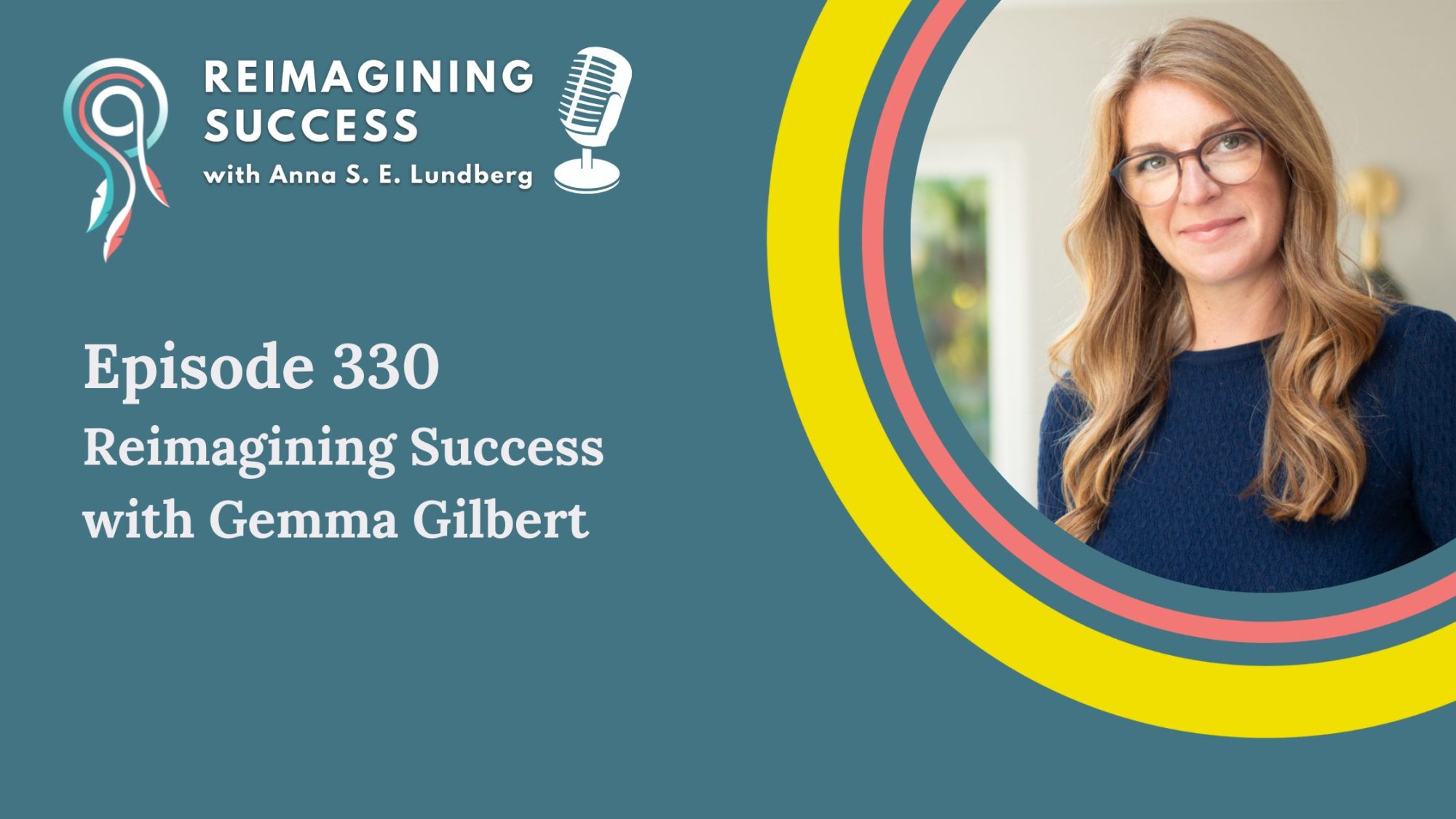


In this week’s episode, Anna interviews Gemma Gilbert, a seasoned entrepreneur and coach who has crafted a successful business helping coaches transition from 1:1 to group programmes.
Gemma opens up about her own journey from being a teacher to selling educational software and eventually setting up her own coaching business. Throughout the conversation, she shares her insights into managing a business that prioritises balance, fun, and authenticity without falling into the trap of overworking.
Tune in to discover how Gemma has successfully implemented a simple, yet effective, business model that supports her lifestyle goals, and learn how you can apply these principles to your own journey towards redefining success.
Connect with Gemma on Facebook and her website.
Key moments:
[00:23] Introduction by Anna Lundberg
[01:27] Gemma’s career journey and the birth of “Mummy’s Got Clients”
[03:32] Defining success and career pivots
[10:00] Transitioning to group programme focus
[13:47] Simplifying the business model
[18:29] Authentic branding and personal growth
[21:02] Balancing work and life dynamics
Resources mentioned:
- Profit First by Mike Michalowicz
- Denise Duffield-Thomas
- Taki Moore
- Gemma Gilbert’s Website
- Gemma’s Facebook Group
- The Business Accelerator
Teaching to Coaching with Gemma Gilbert
Anna Lundberg:
Hello, everyone, and welcome to this month’s interview and I’m here with Gemma Gilbert and she’ll tell you more about what she does in a moment. But I think I came across her originally visiting a Facebook group that was very well known at the time and has grown and continued to be very successful in its various forms. But it was called Mummy’s Got Clients and I think it was before I was a mummy, which is an interesting fact, which I’m sure you will have experienced before Gemma. But anyway, I’d love for you to introduce yourself and tell us, where did you come from? I guess career wise. And what do you do now?
Gemma Gilbert:
Yes, hello. Thanks for having me. Mummy’s Got Clients. It’s such nostalgia for me as well. It was quite a controversial name because a few people said it made you almost sound like, you know, you’re a prostitute of some sort, like, Mommy’s Got Clients.
Anna Lundberg:
And I crossed my mind. But, yeah, this is.
Gemma Gilbert:
This is the funny thing, but for me, this was my original niche. When I first started as a coach, I really resonated with mums who were trying to leave the corporate life because that had been my journey. So I’d started off as a teacher, I’d gone into more corporate life selling educational software. And then I had my son and he just shifted my whole axis and everything that I thought to be true. When I had this little person who I didn’t want to miss a single bedtime for and I was in this corporate travelling sales role where I was regularly away. It was a lot of overnight travel and just emotionally and physically, it was exhausting doing being on the road all the time. And it made me want to figure out crafting my own path, which I trained as a coach and then started helping mums take that shift that I had done and leave the corporate. 9 till 5, which is where Mummy’s Got Clients was born.
Gemma Gilbert:
And then I think, as often happens with niches, I sort of outgrew the niche. I got bored of the mum chat, I got bored of the little kid chat and I just wanted to, I guess, talk about marketing and sales and the thing I love. So my niche evolved and now specifically, I help people grow group programmes because that’s really where I found my sweet spot in client delivery, running group programmes. And it sort of combined all of my teacher experience as well. Because it’s teaching, it’s coaching, it’s mentoring in a group container and I love the energy of running groups.
Anna Lundberg:
And how old is your son now?
Gemma Gilbert:
He’s eight. Okay.
Anna Lundberg:
And so you’ve had a few career.
Anna Lundberg:
Pivots, I suppose, in a way. And within the business, of course, that evolves. And then as you said, you had the moment of having your son. What does success mean to you today? And how has that evolved over the past couple of decades?
Gemma Gilbert:
Yeah, that’s such a good question. And because I really was brought up, I think, to believe that success was career progression. Both my parents were head teachers and I went into teaching and, and got quite disillusioned when I realised basically the only progression was leadership. And I wasn’t motivated by that landscape politically. So I left teaching after. After just thinking, I can’t imagine spending the next 50 years in this environment. As much as I love the teaching side, the workload, the politics, the inequality that we have in our education system. So I went into selling educational software not because I thought this is my passion, but because I saw a great job came up that I thought they’re looking for teach and it’s outside teaching.
Gemma Gilbert:
So, you know, I just took a job and I loved it. But in the middle of that as well, I took a year off to try and write a book. Very, very unsuccessfully. That’s still my dream.
Anna Lundberg:
What you mean? Or was it a kind of.
Gemma Gilbert:
More. There was a fiction book was my, my goal. Now my goal, it’s kind of evolved more into non fiction is, I think, where, where I’m going to write it. When I focus on that, my version of success has evolved. I think, you know, entrepreneurship is one huge personal development journey. I don’t know if you found that, but I’ve grown so monumentally and, and now I realise success for me is balance in my life. I don’t want a break from my job. I want just a life and a job that flow.
Gemma Gilbert:
So for me, a 25 hour work week, disposable cash for experiences and holidays and just feeling in control of, of that B whilst putting good into the world. That’s kind of my version of success now. And I’ve never wanted a big business either. You know, I’ve fallen down the trap of trying to scale, scale, scale and I really like having a medium sized business just making 20 to 30k a month and just flowing with that and I love that.
Anna Lundberg:
And so much of what you post on Facebook, I guess, which is where I see you pop up regularly and resonates with me. And I’d love to dig deeper into the business model. But first it sounds very much like Steve Jobs says that connect the dots, you know, it makes so much sense to move into where you did and then now you’re coaching. But how did you feel leaving teaching especially I guess with the legacy of your parents being headteachers and then changing again and starting entrepreneurship. Was it a natural transition for you? Did you feel confident and Yep, I can do this right away. What were the challenges along those pivots?
Gemma Gilbert:
Well, I definitely felt a worthiness when I was teaching, like I was putting good into the world, being part of the education system, however broken I may believe it to be. And I think I struggle with that as a coach, like being in marketing and sales and business coaches, you know, they get a bad reputation and I, I struggled initially with is this good enough like to be. Even though the actual good is helping people grow businesses, which is wonderful. I did struggle with that. Wondering whether it was as worthy as the profession of teaching, if I’m honest. Big personal development piece for me was my mindset is that when I became an entrepreneur I had to face all of those demons of am I good enough as a person? And I think as a teacher or even in corporate, you know, marketing and sales, as long as you were doing a good job, you were good enough. And I’ve always performed well in those sort of outward scenarios. I can stand in front of a crowd, I can deliver a training, I can sell.
Gemma Gilbert:
It was the inner work that I didn’t, I wasn’t forced to do in those jobs. I didn’t hold a mirror up at any point, not out of, not a willingness to do so they just didn’t really call me to. And I think this is what, how life sort of evolves you is Becoming an entrepreneur, I have had to face all of those visibility fears, those judgement fears, those deep down stories of being good enough and that that’s the thing that’s accelerated my growth the most, is doing that, that inner work. I know it’s a bit of a cliche and everyone says it and do the mindset stuff, but it’s changed me as a person and I’ve evolved now, you know, in the last five years more than I have in the rest of my life.
Anna Lundberg:
Yeah, 100%. What about the resilience in terms of dealing with. I’ve got a post on LinkedIn at the moment with a poll. What’s the biggest challenge of working for yourself? And the leader by far is the income roller coaster. So in those early years, did you feel that pressure of, oh my gosh, I’ve got to get money in versus the oh, I’ve got a steady paycheck, might not be huge, but you know, I’ve got that kind of stability, you.
Gemma Gilbert:
Know, I’m really lucky and that my income’s been pretty consistent in my business since about 2020 or 2019. But even with that consistency of income, if I have a lower income month, especially now, my business has grown and say my expense is just to keep the business running, you know, I have to earn 15k. So if it falls below that, even though it’s not like the I’m not going to lose my house because I’ve built, you know, I use profit first and I use a cash management system that means a bad month isn’t the end of the world. It massively affects my confidence and my mindset when, when I have a bad month and I notice that and I write it regularly in my monthly reviews, I notice if my income goes below 15k or even under 20k, you know, the mindset gremlins start particularly linked to my cycle as well. Like day 20 of my cycle, the doubt creeps in. So yeah, even without typical fe and famine, my mind does feast and famine even at a higher income.
Anna Lundberg:
That’s interesting because the cycle is still feast of famine in a way, even though the, the different. Right, so it’s like never goes away, it’s just shifting higher. And just to say that Gemma mentioned profit first there, it’s a book by Mike Malovitz, if you’re not familiar with it, and it’s around sort of turning the account of the accountancy equation on its head. So profit first, which is good for all of us. So do look that up and so let’s just dig into your business model then I know that you have experienced different models. So could you briefly walk us through sort of the memberships and things that you were successful and I guess the reasons why you moved away from them and towards what you do now?
Gemma Gilbert:
Yeah. So I was lucky enough to fill my one on one relatively fast, say within my first eight months of business. And it took me probably about three weeks into having a full roster to realise it was unsustainable for me. I found the emotional energy of lots and lots of one hour calls in my diary just completely exhausting. And so you sort of saw this ascension model that everyone does. You launch a membership and you launch a group programme, then you launch a mastermind and all these different models that we do. And so I did that at the same time. My first group programme, which was beautifully organic and I just reached out to like six clients that had no, said no to my one on one and said, you want to jump in a group? And they said, yeah.
Gemma Gilbert:
And it was, you know, there was no structure, there was no curriculum, it was just group coaching and a really nice cohort of women mums all growing in the same way. And I loved it and I thought this, this is what I want to be doing. At the same time, I launched a membership that went really well. It was, I don’t really understand why because it didn’t have a particularly strong message. It was very general. You know, if I was critiquing my own message now, I would have said that that won’t be successful. But I guess, you know, when you spent the time building up fans, they will buy what you put out because they want more of you. And so it was just a general get better at marketing and sales to get clients membership.
Gemma Gilbert:
And we ran that for three years and it was wonderful. But the membership model is flawed. It’s. It just is very complicated. Our systems got really complex. We were constantly like having to. I had ended up with two assistants managing like all of the new members, members leaving and then our onboarding wasn’t strong enough and then our attention wasn’ strong enough. Just constantly trying to plug the holes of what happens when you sell lots of low ticket stuff on subscription is that people are flaky and they’re not really paying enough to commit so they don’t show up and then they question the value and then they end up leaving.
Gemma Gilbert:
And so a few years into this I just had this like light bulb moment that memberships can be great. Like if you focus all of your energy on your membership. That’s where I see it really working. But just as like one offer of many, I found it very hard to run. And I saw this mirrored in all of my clients who are doing the same. You, you can grow, you can go to 30 people, easily 100 people, bit more work. We got to 250 and then we were just battling members leaving every month. Like growing a bit members leaving, growing a bit members leaving.
Gemma Gilbert:
And so in this time, this natural evolution of offers, I tested every group offer I could think of, like a 30 day group, a six month group, a mastermind, high ticket, low ticket. And I realised groups and working closely was where I got my kind of energy from. And then I had this realisation that it could be simpler. And I saw Denise Duffield Thomas and Tacky Moore running these like one offer businesses. And I joined Tacky Moore’s programme and every single call he was like, just do one thing, just do one thing, just do one thing. And it was painful because we’d put so much work into our membership. We just rebranded. We’d spent 15k on moving from Podia to Kajabi and it was like all the slickest it had ever been.
Gemma Gilbert:
And I realised I didn’t want to run it anymore and so I shut it all down. That was in 2021. We closed everything just to go in all in on one thing, which is helping more established business owners grow with a group programme, just one group programme. And that’s what I’ve been doing for the last four years now, just focusing on one thing.
Anna Lundberg:
Sorry, you’re not getting bored of doing the same thing? Because that’s one thing I hear from a lot of, you know, multi passionate.
Anna Lundberg:
Oh, I want to do so many.
Anna Lundberg:
Different things and I don’t want to just rinse and repeat. How do you find that?
Gemma Gilbert:
Well, that, you know, in all honesty, your energy does fluctuate like it does. Your energy fluctuates in business. Anyway. Denise Duffield Thomas said once on a call I was with, with her, she, she said, if you get bored, go get a life. Like she bought a rose garden was her thing. She was like, you know, there are so many ways to answer boredom in your life beyond like business model hopping and offer hopping. And that really resonated with me. It was like, what’s the most important thing? For me, it’s simplicity and freedom and fun.
Gemma Gilbert:
It’s very hard to have simplicity and freedom and fun if you’re just running from one thing to the next. My group calls every week stimulate me more than anything. The clients I Have in there are different, the niches are different, the market changes. So the things we’re using in our marketing is evolving. So nothing’s really staying the same because it doesn’t in business. So all it means is that month on month, year on year, I’m becoming the best person to help people at this and very few other people are because most people change tact, most people change direction.
Anna Lundberg:
And you mentioned not wanting to have a big business. And you sort of got this nice place where you’re not really compromising on income. You’ve got the hours, the flexibility, the freedom and the financial abundance. I guess want to call it that. And what would you say are your biggest costs? Is it team? What software? Where does your money go in terms of expenses?
Gemma Gilbert:
Yeah, so my biggest cost is Facebook ads. So I have someone running them and the cost towards them. Now we’re just about to bring that in house. And cost being, you know, big motivation because I often daydream on the how could I cut my expenses in half? How could I not have to earn 30k? You know, what if I could just earn 15k and that give me everything that I want. But then the team would need to shrink. And I love not doing the stuff that my team does. So I play around with this often. My, my assistant, I have like one core assistant that runs.
Gemma Gilbert:
She’s more of an online business manager that does everything. She’s in everything. So it’s my assistant, my Facebook ads person, my Facebook ads cost. And then I’ve just brought on another team member to support with marketing as well. So that’s another. Another cost.
Anna Lundberg:
And one of the things I love about what you post is the sort of, and it’s an overused word, but the authenticity of showing up as yourself and being very transparent about things and challenges and, and what works and, and so on. How have you found the whole sort of personal branding piece of showing up and having a curated image versus, you know, marketing yourself? You’re obviously a great teacher and you’re great at what you do. So how you found the. The marketing piece of marketing yourself and building your personal brand.
Gemma Gilbert:
You know what, I’ve never even considered it a personal brand. I am just myself and I’m a very honest person. And for me, the simplest marketing strategy. I’ve had two people in the last year call me autistic. And I was like, oh, maybe this is it. Because I don’t like my dad said to me once, oh, do you find it embarrassing sharing all the things that you share? And I was like, no, why should I? You know, I just. Just share the things that are in my heart, which feels like the most natural thing to do. So I think even the word curate takes me to, well, what do we start? Who are we conveying if we’re curating anything, you know, it surely it’s simpler just to share our opinions and our point of views and the messy side and, you know, the Brene Brown vulnerability, that’s naturally who I am in my personal life, so that’s naturally who I am in my business Persona as well.
Gemma Gilbert:
In fact, sometimes I guess I ham up my personality a bit. Like, I overly swear in my business Persona probably more than I swear in personal life to kind of, I don’t know, to almost overtly say, this is me, and I don’t brush my hair and I swear and I don’t wear makeup and, like, either accept it or if you’re not comfortable with it, go buy from someone else. And that’s always had a really good response. So you do get that external validation off. People say to me all the time, oh, it’s just so refreshing. You just, you know, you are who you say you are and you do what you say and you prove your expertise through service. And you don’t know how rare that is. So for me, I’m a bit baffled why more.
Gemma Gilbert:
More people aren’t just being themselves wholly in their marketing. I know there’s all these fears and stuff that come into play.
Anna Lundberg:
Yeah, well, there’s the whole thing about even throwing showing up as yourself in the office, let alone in your own business, which is ironic because the whole point is that you’re designing this exactly as you wanted it. So it seems very counterintuitive that you wouldn’t then be yourself. But I think we hold ourselves up to this ideal of, oh, we’ve got to curate this polished personal brand. And I saw a meme about a young girl who was dating and she had like, on the first date, second date, being like, okay, I’m wearing my glasses, no makeup, I’m in my onesie, like, this is me at my worst, take it or leave it. And I think there’s something in that. Isn’t that rather than build up this really high and not even better, but different expectation of who you are, then you’re going to have to keep pretending to be that person in your business, which is. Which is no good for anyone.
Gemma Gilbert:
Totally. And a question I’d get people to ask themselves is, are you being authentic in your personal life? Because I know I don’t have many friends because, well there’s probably many reasons that but like I just don’t have any time for any, any surface level chat. So if you’re not going to show up fully authentically in our friendship and go deep within a few minutes, I just don’t want to waste a moment of this precious life in that false reality. And I think, you know, so if you, if you are that person that say enjoys that more surface level stuff, when you come into business you’re going to struggle because it’s going to command more of you, it’s going to command you develop. And until you step into that increased level of awareness, your marketing is always going to be this vanilla blend in story of what everyone else is saying.
Anna Lundberg:
Yeah, and it’s ironic. It’s a self fulfilling prophecy. We’re trying to protect ourselves from the failure but in doing so we’re almost just making that failure inevitable.
Gemma Gilbert:
Yeah. And you know, earlier you said you get bored doing one thing. I feel I want to add, I don’t just do one thing. I have, I have a backbone and that’s what I like having is like my bread and butter. But I’m also running a mastermind and I also run a programme with another coach. So I think what I like having in business is like what’s the, what’s the focus? What’s the thing that brings in most of the income and then let’s play around that without constantly changing niches or direction.
Anna Lundberg:
I think that’s the balance. Having like a flagship programme and that’s where you really refine it, make it better and better and it’s repetitive but as you say, it’s different people every time. The market’s changing, you’re changing and then you can have fun with the bits around. I know you’ve tried a few in person things and you know, a little mini mastermind accountability, that’s what keeps things interesting. And then I suppose in terms of the practicality of it. Did you mention 24 hours a week? Like what does your weak routine, if there is such a thing, look like?
Gemma Gilbert:
Yeah, 25 hours a week is what I, I go for. So because I’m divorced from my husband, ex husband, we, we have shared custody now which is kind of, you know, reshaped my week a little bit. So I do a longer day on a Tuesday and a Wednesday and then shorter days on Monday, Thursday, Friday. I do client stuff on two and a half days a week and then like Monday and Friday are totally back office creative days. No calls at all, no emails, just creative time and it, but it’s tight. You know, this is one of the things I repeatedly reflect on year on year. There’s no leeway. So if I do like an in person day or join stuff, something has to give and I’m not really willing to work more.
Gemma Gilbert:
So after I’ve tested doing different stuff, I’ve sort of settled into a rhythm of okay, I’m at a point in my life, we’re seeing my son on the days I have him is the most important thing. And that means I’m not going to do much in person stuff. I’m not going to do any networking, I’m not going to do anything other than run Facebook ads, do my client calls and do my marketing and my creative stuff.
Anna Lundberg:
I think that’s important. Maybe we get greedy or even it’s that sort of scarcity minds that we think we’ve got to do more. We can’t possibly say no to something and keep adding. Whereas being super clear and confident in who you are, what’s important to you just helps you keep those boundaries and yeah, keep your successful business going without adding more to your plate.
Gemma Gilbert:
And I think also a reflection point to me is you can have a dream and it not need to be fulfilled now. So like I’ve always wanted to do more speaking. I’ve always wanted to write a book and you know, I could beat myself up as a failure for not having done those things yet. But I experimented with speaking last year and the impact on my energy and my workload was massive. And I did three speaking gigs for the whole year. And so the idea of making that part of a regular strategy, knowing what my priority is, just doesn’t make sense.
Anna Lundberg:
Yeah, that’s such an important reminder. And you mentioned writing before. I always wanted to be a writer and I imagine that, you know, sitting by the lake somewhere just writing, that’s not the reality. It can be quite tedious and you have to, you know, if you don’t want to sit by yourself writing all the time, then being a writer isn’t necessarily the kind of career, if you can even call it that for you. So I think questioning those, oh, I want to be a TED speaker or a writer, an author. Of course it’s never that black and white anyway because we wear so many different hats. But I think it’s important to understand what goes into what’s sort of the iceberg underneath that shiny achievement. And if we’re ready at this point of our lives to give something else up because something does have to give.
Gemma Gilbert:
Totally. And you know, a realisation I had last year was that when I’m at my best, when people are like really like when I feel flowy and everyone is like, wow, you know, you’re so like on it right now is when I’m responding to others, it’s not when I’m sitting writing endlessly on my own. So that realisation was like, oh, okay, I need to fill my time with times where I’m responding, not having just endless creative time where I’m writing on.
Anna Lundberg:
My own or a monologue. Yeah, absolutely. I’d love to continue talking, but in the interest of time and respecting yours and the listeners and in the interest of work life integration, we have to run and pick up my son. I’d love to ask you where we can find out more about your programme and connect with you on social.
Gemma Gilbert:
Yeah, so the main thing to do is get on my email list. That’s my kind of secret sanctum of where I share my best ideas. So just go to my website, gemmagilbert.com and I’ve got a couple of free things you can grab on there to get onto my email list. If you want to join me on social, I’m there very sporadically on Facebook. I have a Facebook group called Gemma Gilbert Grow with group programmes and I am there sometimes.
WORK WITH ANNA
Let us help you design a business and a life that gives you freedom from the 9 to 5. There are several options for how you can work with us. Choose the programme that’s right for you.
The Outsiders Business Incubator
A year-long business incubator for experienced corporate professionals who want to translate their skills and passions into a profitable and fulfilling business. onestepoutside.com/9to5
The Outsiders Business Accelerator
An ongoing mastermind for service-based business owners, freelancers and online entrepreneurs who are ready to achieve success on their own terms. onestepoutside.com/accelerate
The Outsiders Business Academy
A self-paced course for you to work through in your own time, to learn – and implement – the foundations of building a profitable business that lets you escape the 9 to 5. onestepoutside.com/course
1:1 Coaching & Mentoring
If you’re looking for one-to-one support to help you achieve your specific life and business goals, Anna has a limited number of spots for individual coaching and mentoring. onestepoutside.com/coaching
Explore a broader definition of success
Download this free assessment to consider what ‘success’ means to you across different areas of your life, evaluate where you are today, and prioritise the right goals to get you to where you want to be.


