
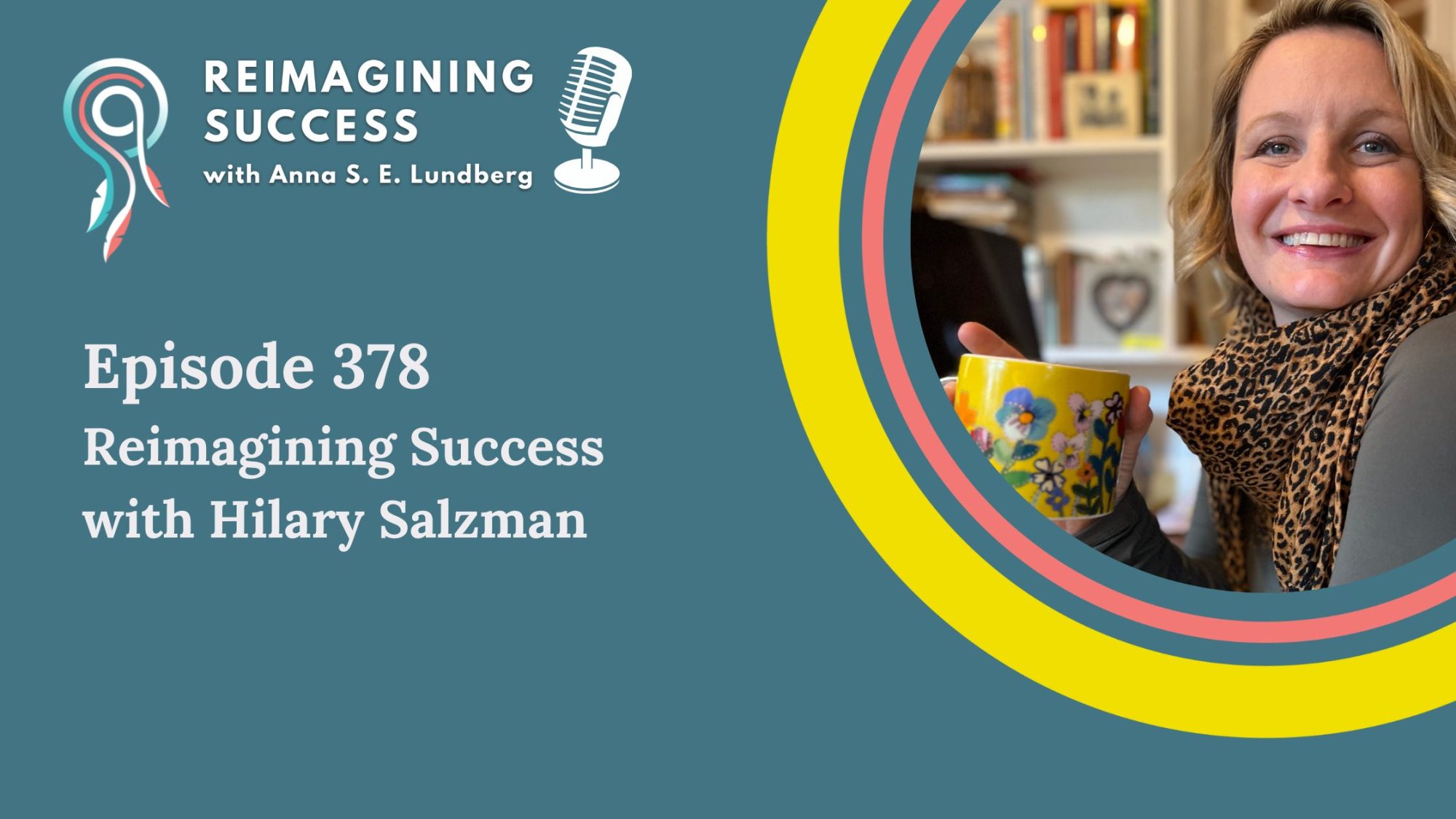


Hilary Salzman reflects on her journey from chasing externally defined success to building a life and business shaped by autonomy, “enough”, and impact. We explore how business storytelling became both her work and her way of taking up space – and why midlife can be the perfect time to rewrite the story.
Key Moments
[00:15] What a “business storyteller” actually does – Helping female founders uncover their voice and take up space through story.
[00:58] Redefining success in midlife – Moving from money and external validation to impact, joy, and self-defined success.
[03:17] When the “right path” doesn’t fit – Dropping out of university, absorbing family expectations, and reframing difference as a strength.
[05:55] Parenting and inherited success stories – Catching yourself steering your child towards “safe” choices, and choosing a different approach.
[07:42] Why discouragement kills ambition – Creativity, innovation, and even whole careers can die when we shut down possibility too early.
[08:58] The freedom paradox – Following a clear blueprint can feel safer than having endless options (and doing nothing).
[11:47] The midlife confidence dip – More experience, less confidence… and the cultural story that midlife women should “take up less space”.
[16:47] Hilary’s turning points – Leaving university, journalism disappointment, marketing ladder-climbing, and the 2008 leap into freelancing.
[24:49] “Enough” vs. more – Detaching success from money, choosing security and wellbeing over burnout, and embracing the trade-offs.
[33:37] How Hilary’s business works now – Hybrid model (1:1 storytelling + She Roars Club accountability), plus Substack and book writing.
[39:57] Designing day-to-day freedom – Flexible hours, finishing around 4pm, protecting weekends, and choosing work rhythm by season.
[43:14] 2026 focus without the “empire” pressure – Doubling down on what’s working, writing book two, and keeping the ripple effect going.
Resources mentioned:
Hilary Salzman – business storytelling expert (website)
The Roar of Her Story (Hilary’s book)
She Roars Club (accountability/community + storytelling support)
Substack: Speaking in Stories
Instagram: @hilarysalzmanstories
LinkedIn: Hilary Salzman
- Apply to Architect (12-week small cohort for experienced solopreneurs)
1:1 Coaching & Mentoring
For experienced founders and independents who want a trusted thinking partner – not a programme or a group, but direct, personalised work at the level you’re actually operating at. Anna works with a very small number of clients at any one time.
Business Storytelling
Anna Lundberg
Hello everyone and welcome to this month’s interview. I’m here with Hilary Salzman, and I’ll hand straight over to her and ask her to introduce herself better than I possibly could. So Hilary, thanks so much for coming on.
Hilary Salzman
Oh thank you for inviting me Anna. Gosh — yes, so I am a business storyteller, which always sounds something quite mystical, but essentially I work with female founders and business owners and brands, small brands in particular, helping them uncover their voice and use their experiences and insights through storytelling to help them connect with their customers — but also to kind of help them grow themselves and feel like they’re really taking up the space that they deserve to take up with their voice and their stories.
Anna Lundberg
I love that. And we’ll hear more about that in a moment. Given that story of your storytelling, I’m curious to know: how do you define success at this stage of your life and business?
Hilary Salzman
Oh gosh, that’s a big question, isn’t it. Success is a funny thing because I think like many people I grew up thinking success equals money, it’s hard work, it’s going to university, it’s — in my case, in my family — it’s getting a job in the NHS. Having “doctor” in front of your name seems to help in my family… but I was rubbish at science at school, I had no interest in that. So I already sort of felt out of kilter with success.
I’ve gone through so many different iterations of what I think success is, based on external forces mainly. And I think now in my mid-40s, success is about being able to write what that means myself and no longer having to feel like I’ve got to be successful by my parents’ terms or by my peers’ terms or by colleagues’ terms. It is about really feeling that for the first time I know who I am, and therefore the work that I do fills me with absolute joy.
Knowing I’m making an impact — that to me is success. And there’s various versions of that. I look at success in terms of what it enables me to do in my life, and how I run my life, and how my relationships are, and how my family works. But for me it’s that kind of finally knowing who I am and not being afraid to go out and tell people and having that platform.
I mean, I get to talk to amazing women every day and share my story and share their stories. I feel pretty successful in that.
Anna Lundberg
I love that — and it’s so rare to hear someone put it that way. It’s so nice to hear that you rounded off that little story to say “I feel pretty successful.” That’s really nice to hear. And it’s interesting, isn’t it, how we’re so formed by what our parents did and expected… with doctors in the family. The men in my family at least were engineers, but my parents were — well, my mum was very academic, so those things really anchor you so much in the lens through which you see everything.
Hilary Salzman
Yeah, massively. And it kind of doesn’t enable you to see another route. I’m the youngest of three, so the pressure was always there. I remember making decisions about going to university and I didn’t contemplate there might be other options because that’s what everybody did.
And then I hated university and I dropped out after a year, so already I had failed — because success in my family was going to university and getting a job. So I’d failed at that. And I went through these series of things where I was trying throughout my life and my career to do what other people did, what I saw these other people doing. And every time it didn’t fit because it wasn’t the right choice for me… and I would chalk it up as another failure.
It’s been a really long journey of accepting that I am different to my brothers and sisters and my mum and my dad — and a lot of my friends as well. And that’s a good thing. Being able to recognise that now in midlife is one of the markers of success for me: being honest with myself.
Anna Lundberg
So interesting. It makes me think about cultural origins too — in England with names like Baker and so on, your name used to literally be your profession. In Sweden, historically, you’d be defined by your relationship to your parents — Sven’s son, Sven’s daughter. It’s an undercurrent that’s been there for a long time. It’s gone from being a shoemaker like your father to now going to university because that’s what everyone does… even though you don’t really know what to do with it.
Hilary Salzman
Yeah. My name means salt seller — that would have been my profession at some point back in my ancestry! But it’s all these weird forces, isn’t it. No matter which way we look we’re kind of defined. Everyone is trying to tell us what success means, but they’re not necessarily trying to tell us how to find that inner success and have the autonomy to say: I’m defining success my way, and that’s okay.
I’ve got a 17 year old daughter, and navigating all this… a couple of years ago I found myself trying to guide her down paths: you need a good job, you need to be a lawyer, you need to do this. And she came to me saying “I want to be an actor,” and I was like: you can’t be an actor, you can’t be successful. And I’m like… come on. Don’t make the same mistakes generations make — just let her be.
Anna Lundberg
And make different mistakes. We’ll go the other direction and we’ll make other mistakes.
Hilary Salzman
Yeah. And ambition dies. Creativity dies. Innovation dies. This is the problem when we’re led into or told not to do things or told we’ve got to go certain ways. The way we can use our brains to think up jobs that maybe don’t even exist… I have a client who’s a TikTok coach. In COVID she was like, right, I don’t really know if there’s a job in TikTok, but I’m just going to create a job. Six years down the line she’s one of the experts in TikTok for businesses.
I love that ability to say: I feel something, there’s an opportunity here, I’m going to go for it — versus “get a good job and steadily climb the ladder.” I spent almost two decades doing that in corporate. I think gosh, I wasted a lot of time — but it was part of the learning: failing, learning, figuring out what I liked and didn’t like, to define success now.
Anna Lundberg
And it’s easier in the short term to follow the blueprint: corporate levels, promotions, salary, someone telling you where to be. That’s the anti-side of freedom. Too much freedom can be overwhelming: who am I, what do I want, I could do anything — so you end up doing nothing. So there’s safety in having a clear frame to operate within.
Hilary Salzman
Yeah. And there’s privilege too — some people can take financial risks earlier. For others, having a blueprint gives some direction. But it still doesn’t have to be traditional routes, and there are more alternatives now. And you kind of need some structure to figure out what you don’t like as much as what you do like.
If I tried to do this at 19 I wouldn’t have a clue. Working with midlife women is fascinating because we have so much experience: what we’ve learned, screwed up, done. We’ve got this ton of experience, so let it shine. We’ve made choices — wrong or right — and we’re here now for a reason.
Anna Lundberg
It’s interesting too: when we come out of university we can be very confident with zero experience. Twenty years later, we have incredible experience and then we doubt ourselves. Do you see that as well?
Hilary Salzman
Yes, massively. Society tells us we don’t deserve to take up space anymore, that we should settle down. It’s nonsense. Even women who resist that still find it hard to talk about themselves and their successes. I still struggle sometimes: who am I to do this? But midlife women are not going quietly.
Anna Lundberg
It’s the “I don’t care” phase — you stop caring about external metrics. Since they stopped caring about us, we stop caring about them. We can do what we want.
Hilary Salzman
Totally. You’re going to abandon us — we’ll abandon you.
Anna Lundberg
I saw something saying the average successful tech founder is 45 when they start. You think you’re behind, but actually we’re entering our best age. Do we need to go through the phase of following the path first?
Hilary Salzman
For me, I don’t think I could do what I’m doing now without the corporate experience. Without feeling silenced and wanting to change, I’m not sure I’d be as qualified to help women going through the same. But I met someone our age who’s never worked for anyone else since 16 — and she doesn’t have these hang-ups. She came from a family of entrepreneurs and was encouraged. If I tried at 16 my parents would have said: don’t be ridiculous.
It’s hard to know. But it’s not to say we can’t rewrite the story now. The idea we’re past it is nonsense. We are in the perfect position to rewrite our story.
Anna Lundberg
What triggered you to leave university, then later corporate?
Hilary Salzman
I hadn’t really wanted to go. I wanted to work. I was studying journalism and frustrated we only did three hours of journalism a week and the rest was philosophy and statistics and Spanish. I left to work for a newspaper, and it was hideous. Again I was like: what is wrong with me?
Then I got into marketing because I needed a job and I liked to write. I liked being in a team. I enjoyed it at first, but quickly I was part of an engine: had to be better, earn more money, get the next role. Even though I didn’t enjoy it, I stayed because I didn’t know what else to do — and I couldn’t quit another thing.
I had my daughter at 28. I went back to Vodafone after maternity leave and thought: I cannot do this. Commuting an hour either side, supposedly doing three days but it was five days’ worth of work in three days. Nothing had moved forward while I was away. In 2008 — in the recession — I quit my well-paid stable job with benefits and pension, and decided to go freelance because I couldn’t live that life anymore.
Then I got divorced around the same time, with a two-year-old. And there was a narrative around failure: left university, left corporate, got divorced — I’m rubbish. But you’re just doing what you’ve got to do in the moment and finding your feet.
I set up an agency, and it worked until it didn’t. It gave me freedom and financial success, but still didn’t feel right. Seven years ago I said: that’s it. I want to work for myself, do things my way, and help other women. Now I’ve carved out this niche as a storyteller for women.
Anna Lundberg
And it’s clear how the path evolved organically. There’s so much unlearning to get to “I really can do anything I want here.”
Hilary Salzman
Yes. It’s trial and error. I’ve had to do quite a lot of work on myself. I’m not someone who can sit and strategise big plans — I know what I want to do with my voice and how I want to help women. So I try things, put something out there, launch something, see how it lands. That’s success to me.
And freedom for me isn’t just balance — it’s creative freedom. I don’t have to run my ideas past other people. I can experiment. I’m not very good at people telling me what to do. In corporate my creativity felt dampened. Now I can put something out and if it fails, so what — I’ll learn.
I earn less money now than I did in corporate and running the agency, but success isn’t mega bucks for me. It’s security and not burning myself out. When I was running the agency I earned more but I was knackered, not creative, my mental health dropped massively. Now it’s about earning enough to feel secure and build the life I want, without burning out. And yes, the income isn’t always regular — but I’d always take this over the old way.
Anna Lundberg
Same. That word “enough” is so important. More money beyond what you need can bring mental and physical health issues, time away from kids, and so on. You can choose “this is enough now.” And if you ever want to increase the money, you can think about doing that differently so you don’t sacrifice freedom and peace.
Hilary Salzman
Yes. Detaching success and money is huge. If you’re not earning what you think you “should”, you can tell yourself you’re failing. But if what you’re earning is enough, and you have a nice lifestyle and take Fridays off or school holidays off, that’s success. I used to take the whole summer holidays off — the whole of August — and that felt like the best luxury in the world.
Anna Lundberg
And it’s bringing it back to presence — what matters now. We’re privileged to be in a situation where that’s possible, and all the more important to use it well. We can become our own worst boss, setting goals no one else asked for. What’s the point of that?
Hilary Salzman
Yes — you are your own boss. You can work whichever way you want. But there’s so much around standards and “professionalism” that doesn’t serve us anymore — not women, not anyone who doesn’t fit the mould.
It’s not surprising women are setting up small businesses and leaving corporate. The system isn’t changing, so what do we do? We set up our own businesses. I hope the small businesses of now become the bigger businesses of the future.
Anna Lundberg
And the ripple effect matters. Every time we design our own version, we change something. The more we talk about it, the more it filters down. Sometimes it’s one conversation, showing your children a different narrative than TGIF and Sunday scaries.
Hilary Salzman
Exactly. If we can all be free to view success on our terms, that would be amazing.
Anna Lundberg
Tell us more about what you’ve built now. How do you work?
Hilary Salzman
It’s a hybrid model. I do one-to-one work with female founders and with small brands — face to face or on Zoom — and I help them explore everything in their brain: stories, experiences, insights, self-talk. There’s an element that’s coaching-adjacent, even though I’m not a coach. It’s helping them see the value in their experiences and create a narrative that’s true to them, even if it pushes them.
We work on what story they want to tell, how it connects to what their customers need, and I wordsmith it into foundational narratives they can use for funding, social media messaging, website, talks — and as an anchor when they have wobbly moments and forget what they’re doing.
I also have a small and growing membership called the She Roars Club, which is about accountability. There are some online courses, but the point is to create a space to set goals, be held accountable, and talk through fears and blockers around sharing your story.
I’m an author — I wrote The Roar of Her Story and I’m writing a second book now. And I love talking about this work, making it accessible. We have incredible power in our story. It’s not just marketing — it’s power, it’s feminist, it’s unique.
Anna Lundberg
I love that. It also helps with the fear of self-promotion: it’s not “look at me”, it’s “this matters”.
How do you spread the word? How do people find you?
Hilary Salzman
Social media. I have a Substack which I love because it lets me write long-form — it’s called Speaking in Stories. There’s a weekly article and I share a lot of insight into my own world too. LinkedIn is big for me, and Instagram as well — I love the community there. And my website.
Anna Lundberg
And what does day-to-day look like now? Do you have strict boundaries?
Hilary Salzman
I’m less strict now because I don’t need to be. I still finish around four-ish — the dog needs walking. My partner works from home, so we walk the dog, breakfast together… it’s often 10 o’clock by the time I get into my office. It feels really nice.
I’m protective of weekends unless I’m deep in something creative, like writing. I choose to work then because I want to. I took three weeks out for a tour of America after my daughter’s GCSEs. Things change, and I can change my working hours with life. If I was corporate it would still be nine to five.
Sometimes I dial it up for deadlines; other times I’ll do some work, write content, and then have coffee with a friend or go shopping. Today my daughter’s off college — we’re decorating the house. Those things sound small, but the ability to do them is everything.
Anna Lundberg
It’s absurd to think nine-to-five works for everyone at every life stage. And it’s up to us to show other ways are possible.
I’ll put your links in the show notes. Final question: what’s coming in 2026 and beyond?
Hilary Salzman
More of the same, really. The last couple of years have been quite a lot of new stuff, and if I try to do too much new, I miss the goodness of what I’ve created. So: focus on one-to-ones, focus on accountability, get book number two out, and I’m working on a side product with ChatGPT. But mainly it’s keeping going, making those ripples of change, steadily and consistently.
Anna Lundberg
I love that — permission to do it your way, permission to define “enough”, and permission to not need audacious goals every year. Thank you so much, Hilary, for sharing your story so beautifully.
Hilary Salzman
Thank you so much, Anna. It’s been great fun.
WORK WITH ANNA
Let us help you design a business and a life that gives you freedom from the 9 to 5. There are several options for how you can work with us. Choose the programme that’s right for you.
The Outsiders Business Accelerator
A mastermind for service-based business owners, freelancers and online entrepreneurs who are ready to achieve success on their own terms. onestepoutside.com/accelerate
1:1 Coaching & Mentoring
If you’re looking for one-to-one support to help you achieve your specific life and business goals, Anna has a limited number of spots for individual coaching and mentoring. onestepoutside.com/coaching
Off Script community
A community for established independents who’ve chosen their own definition of success and want a room of people who’ve made the same choice.


