
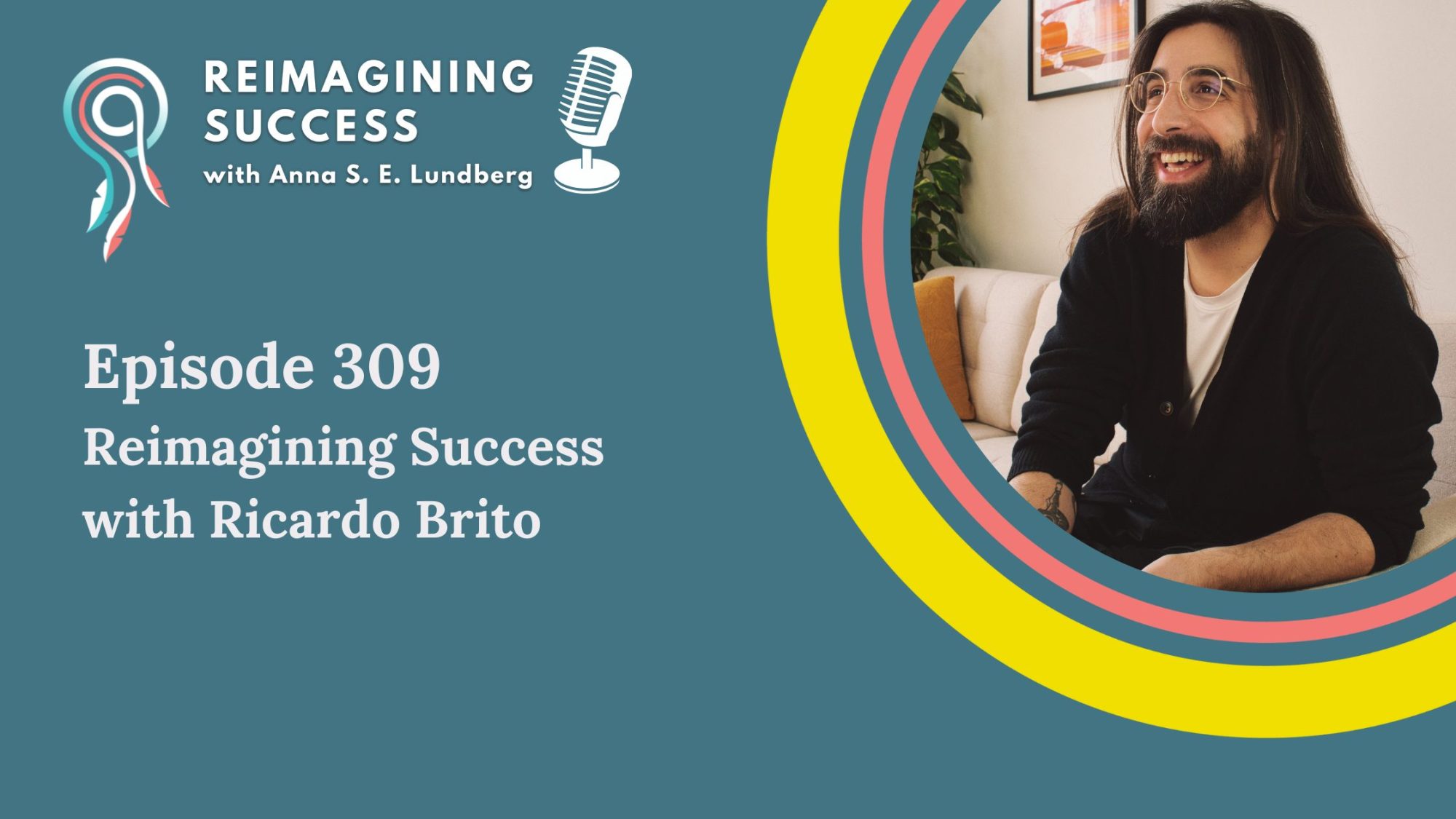


 In today’s episode, we share an inspiring interview featuring the multi-faceted Ricardo Brito. Ricardo is currently a work and life coach focused on career storytelling, but his professional journey is anything but conventional. He began his career in the old school world of graphic design and branding in Portugal, transitioned into the tech industry with a twelve-year stint in product innovation and design in Germany, and eventually found his calling in coaching after experiencing a significant burnout. Now based in Berlin but frequently visiting family in Portugal, Ricardo has successfully built his own coaching business. In this episode, he shares his story of career pivots, the personal challenges he’s navigated, and his insights into creating a meaningful and autonomous work life. Join us as Ricardo and I delve into the twists and turns that have defined his career and his thoughts on redefining success.
Connect with Ricardo on his website or LinkedIn.
00:00 Career transition from branding to UX design.
04:43 Success: job, career growth, sustainability despite challenges.
08:05 Strategic savings, emotional work, bureaucratic fear.
10:29 Attracting people at different life stages, explorative. Helping secure individuals make transition plans.
13:50 Overcoming doubt, embracing creativity, and growing business.
17:34 Embrace your uniqueness and value audience feedback.
23:29 Transitioning from rigid schedules to flexible spontaneity.
24:14 Productivity without digital to-do lists, satisfaction.
*Resources mentioned during the episode*
1:1 Coaching & Mentoring – If you’re looking for one-to-one support to help you achieve your specific life and business goals, Anna has a limited number of spots for individual coaching and mentoring. www.onestepoutside.com/coaching
Career storytelling
Anna Lundberg:
Okay. Hello, everybody, and welcome back to this month’s interview. After a bit of a break over the summer. I’m here with Ricardo Brito and I’m going to, as ever, go straight in and ask you, Ricardo, to introduce yourself as only you can. So we’d love to hear. Who are you, what were you doing before? And what are you doing today?
Ricardo Brito:
Hi, Anna. Thank you so much for having me here. So I’m a coach. I’m a work and life coach right now, but before I had a twelve year career in tech, and before that I come from the old school world of graphic design and branding and advertisement and all of those fun stuff.
Anna Lundberg:
I like that you called it old school. I also worked in brand management and I think it’s certainly still pretty relevant. But it’s an interesting transition for you to go through, which we’ll dig into more and your home in Portugal as we speak. Right.
Ricardo Brito:
As we speak. I’m in Portugal. That was one of the advantages of having our own business, right, is to move where we want to be. And also, I’m now visiting my family, but I’m usually based in Berlin.
Anna Lundberg:
Nice. Okay, well, really nice to speak to you. So I guess, talk us through. I mean, you talked the initial career transition, I guess, a long time ago, you moved sort of from the brand space into tech and then, perhaps more interestingly, for our purposes, took the leap to work for yourselves. And can you talk us through a few of those twists and turns along the way?
Ricardo Brito:
Yeah. So the first twist and turn was that I had a semi decent career in Portugal in branding and advertisement and all of that field. When I moved to Germany, I saw that this field was dying and I was like, oh, I need to do something different, but I didn’t know how. And I realised UX was coming up as a new thing and I was like, okay, I became an intern again, which was a bit of a punch in the stomach. And from that point I created a career of twelve years around product innovation and design. And after those twelve years, I had a huge burnout. And that burnout during those eight months where I was finally asking myself what I really wanted to do in my life, because actually I never asked myself. I just somehow reacted, understood that I needed out of tech.
Ricardo Brito:
And by accident I discovered coaching and started that discovery part. And then the other part was creating my own business. That’s something that was very surprising. I never wanted to do it. I grew up in a family businesses. I said, there’s no way I’m going to run my own business. I want to be employed and that’s it. But here we are two years later, two years and a half later, I’m running my own business.
Anna Lundberg:
So interesting how our family upbringing and what we see and experience affects us. I mean, I always think, you know, if you’ve got the kind of, I guess, corporate, professional, academic parents, then you tend to follow that a bit, like, I don’t know, the hat makers son, the baker’s son, follows in their footprints. But the other version of that, I guess, as you say, is if you see your parents struggling or stressed or always away with their work or something like that, then that’s likely to have the opposite effect. So that’s really interesting that you sort of. Yeah. You didn’t feel like the path you wanted to follow.
Ricardo Brito:
Yes, totally.
Anna Lundberg:
Yeah. And the moments of pivoting are really interesting too. So the first one sounded very intentional and very smart. You were looking to kind of future proof your career, really. You saw a dying industry and you jumped on, you know, you upskilled, you made sure that you’re current and so on. And then the second pivot, as you said, is more of kind of a forced moment of having to reconsider. And it’s so interesting how you said as well that it’s kind of accidental how you discovered coaching. I think that happens to a lot of us, that we go through our own process of working with someone and self development and so on, and then that kind of becomes something that’s so powerful for us that we want to help other people doing that as well.
Ricardo Brito:
Yeah. And for me was the coaching part was something that I realised that although I was working in very technical fields, like. No, I was, you know, doing graphics or organising campaigns or like building products, the part that also building teams. But the part that I really loved was the human part of my job, but I was kind of, oh, that’s something I do and I love. I never understood how that could actually be my next thing. Right. Because coaching was very much drinking from that side of my work and. Yeah.
Ricardo Brito:
Which creates here a discussion about transferable skills too. But, yeah, it’s interesting how we discover those things.
Anna Lundberg:
Yeah, absolutely. And of course, the podcast is called reimagining success. And I’m curious, you know, you said that you hadn’t really asked yourself what was important to you and what you wanted, but when you first started, I guess initially when, yeah, you didn’t want to follow in your parents footprints and you kind of followed this other path. How did you look at success in the early stages of your career. And then obviously, really interestingly, how do you see success today?
Ricardo Brito:
So, definition of success by the age of 16 was that I want a job where I can dress as I want, which might be a very reduction way to see success coming from Portugal. Also, like, I came out of university right straight to the financial crisis. So a success would be having a job. A better success would have been having a job in your area. I was very lucky that no matter how bad the economy was, I always find jobs in my area and I always made myself marketable in some shape or form. So that was the definition of success when I moved to Germany and I wanted to have a better lifestyle, which I quit the job in the middle of the crisis, and everybody was like, what are you doing? Become an intern. Again, the definition of success there was like, I want to have a proper career. I want to have, like, I want to grow in this field, because this field will also give me sustainability.
Ricardo Brito:
Like financial sustainability. And also it’s a field that I really enjoy. But there was always this money aspect to it. Later on, I think I got lost in the world of tech, right? Like, you know, more money, more prestige, more status, more this, more debt. And then kind of like just a pot balloon of empty stuff. And then right now, after my burnout, definition of success is, can I have a very decent lifestyle? Do I do work that matters to me, even if I work way more than before? Am I taking care of myself? Do I have time to take care of myself? And do I have time to be with the people I want? My partner, my family, everyone. So one of the reasons of building a business for me was, I want to move, I want to visit my parents. I’m not in kindergarten.
Ricardo Brito:
I hated this concept of asking my boss, can I please go out? I’m not a child. So that’s already a big definition of success too. Independence.
Anna Lundberg:
Yeah, independence and autonomy. That’s really interesting. I saw someone who, to be fair to him, was a CEO of an organisation saying, hey, stop asking me. I hate it when you ask me, oh, is it okay if I leave early to pick up my sick child? And I’m so sorry I came and left. You’re not in kindergarten, as you said, you don’t need to ask to go to the toilet. I trust you to do a job. And I wish, and I suppose, hope that more employers are thinking that way. But unfortunately, in the meantime, working for yourself, or fortunately, perhaps for us, is a great way to create that autonomy.
Anna Lundberg:
And it sounds like quite a simple definition of success. So beautiful, totally should be feasible and yet surprisingly difficult to build and create for yourself. What have been the main challenges in the last few years after making that decision to work for yourself? What have you come up against in terms of hurdles and difficulties?
Ricardo Brito:
Well, one of the things that I was always afraid of, and this comes from this scarcity mindset, you know, is the financial, right. I mean, there’s three drugs in the world. They say it’s sugar, cocaine and a paycheck. I was definitely hooked with a paycheck, so I was taking the leap was really. Was really scary, right? Like, I will not have that. That money at the end of the month every time, like, no matter if I do a good job or a bad job. So I think that was the first hurdle, which was both emotional and practical. The practicality, I did it because I prepared for this move somehow.
Ricardo Brito:
I had savings, I had support systems for that, and I was strategic about that change. The emotional part took a lot more work. Like, you know, diving into money, belief, the relationship with money and all of that. I think that was one of the biggest hurdles. The second one was, there is a funny word for that in German. It’s called briefcast angst, which is, you are afraid of your mailbox because you receive so many letters that there is so much bureaucracy that there is a word for that in German. So up until the moment I run my business, and, look, I’m a grown up man, I’m 37, could be grown up, but I needed somebody to come with me to open my mailbox because I was so afraid of bureaucracy. Right now, I’m at the point, it’s just like, where is the goddamn ladder? So I think those two hurdles were very crippling.
Ricardo Brito:
Maybe it was not the most traditional ones to have, but those two hurdles were very crippling at the beginning.
Anna Lundberg:
Well, certainly the financial fear is normal. And I like how you distinguish between the tangible, concrete, hey, I need to make money and pay my bills, and then arguably, as you say, the harder bit, the emotional, limiting belief piece, I think most of us focus on just that. Oh, I need a strategy, I need a plan, I need savings. But actually, that’s sort of the easy part, almost. We can. That’s a strategy we can make. It’s more the other stuff. The confidence is the resilience to deal with the ups and downs.
Anna Lundberg:
So that’s interesting. And, yeah, German has great words. There’s Torsch. Luz Panik was one of my favourites that I discovered, which was the fear of closing doors. I don’t know who taught me that, but I used to like to keep all my options open, forgetting that, of course, if you don’t close the doors, then life will close them for you and you don’t get to choose. So that was a big one. And I think I’ll stop. I love that anymore.
Anna Lundberg:
There’s another one which I won’t try to remember in German, but you can’t dance at all the weddings, which I think is great too. It’s a bit of the FoMo. You can’t. You know, if I see my colleagues going to big award shows and travelling with their corporate jobs, you know, I have all the other great stuff for working myself. I can’t also then have the stuff that’s from the corporate world. I think that’s the sort of thing. But great german language is awesome in terms of clearly very descriptive terms for what we face. And that’s a great one.
Anna Lundberg:
I remember that one. So what does business look like for you then? You’ve had, I guess, three years almost to kind of experiment and start to consolidate. So what is your business model? Who do you work with? What do you do?
Ricardo Brito:
Yeah, so I understood that I was attracting people into different phases of their lives, which was either people who were not ready to take action, but they were ready to start exploring what a new future for them could look like. So it’s more on the explorative side of things. On the other side is people who have been. Who have already a couple of actions. They did some sort of work on themselves, so they are a little bit more secure about where they want to go in terms of options, and then they need help into making the right choice and then making a transition plan and getting to where they want to be. So those, I would say those two segments, they tend to be people who are mid career, although I have the odd ones, very young, or people who try. I just need to keep this job for the next two years because I’m about to retire. How do I do that? Those are more the odd ends.
Ricardo Brito:
But generally, these people have been working in most fields. I’ve been working with tech people, comes from the creative side, business side. It’s very varied in terms of backgrounds, but they are mid careers and they want to take a better control over their. Over their work life and creating a better relationship with work as they are doing this. And business for me, looks like I work a lot. One on one. That’s one of the things that I love, too. It’s just these moments.
Ricardo Brito:
The one on one, I’m now starting working with groups. I’m also creating a solopreneur cohort to help people to build their own business, because that’s what comes up for a lot of people. Just meet career. They go, what? I’m done. I just want to do my own thing. How can we do this? And I run workshops, talk at conferences. I try to mix and match because that’s the fun of adding our own business. Right? Yeah.
Anna Lundberg:
I find that such a difficult balance for people to get right, of finding a formula that works and then being consistent and kind of doing the boring thing of just showing up and doing what you’re supposed to be doing, but then keeping it really interesting and fun for you as well. Right. I almost found that harder because I left my job. Well, almost, oh, gosh, eleven years ago now. And, you know, after a while, you sort of do the same thing, same thing, and then suddenly you go, oh, it’s not really fun anymore, and how can I keep it greater? Plus, of course, the world changes, the market changes, technology is changing, people change, and so on. Right? So there’s always, you can’t really rest on your laurels anyway. You need to keep things interesting. And you mentioned talking at workshops.
Anna Lundberg:
Workshops, sorry, you mentioned talking at conferences and running workshops. And also, of course, you’re here on this podcast. So how are you getting in front of audiences? How are you finding the process of building your personal brand to get people to know, like and trust you, as they say in the business?
Ricardo Brito:
I was always, like, very external facing in every company. I was trying to get into conference, talking about things I wanted to talk about, and the company was kind of supporting me. So this aspect of becoming more of a public facing kind of character, Washington, something that I really enjoy. And also being in conference as a designer running workshops, I really like to be close with the community. So that part on the skills side, let’s say, came naturally. Right? I have a lot of knowledge in building brands and building products. So that also feeds on the technical side. Now comes the cringy part is just like, oh, wait a second, because now I’m representing myself and I am the product.
Ricardo Brito:
And that’s a twist, right? So with my coach, at a certain point she said, you have so much to say, why don’t you write an article? Oh, no, I don’t have nothing to share. And so on. Just write an article. Like the Internet forgives. And I wrote, and then it comes up, it became a newsletter that one year after I had like 800 people, which were okay, and so with that, I hired somebody to help me with my brand positioning and the content strategy and to really like, do I really want to invest in this? And this person also changed my mind. Like, look, it’s your business. Do what’s fun for you, do what you like to do and just do it. So I started to do videos, I started to do the newsletters where I can draw and make use of my illustration skills so I don’t lose that.
Ricardo Brito:
And people love the cartoons. I try to be in conference, I try to give workshops. I do a lot of also some sort of webinars and community work for free. And I just put myself out there. But I needed to jump to this cringy wave. I’m not sure how was it for you of, okay, now I’m doing this and putting myself out there.
Anna Lundberg:
Well, there’s, again, there’s so many fears, right? There’s that, oh my gosh, people are watching and reading and what will they think? And the reality is when you first put something out, nobody is watching. So that’s the good thing, right?
Ricardo Brito:
Yes.
Anna Lundberg:
My first blog post out, nobody cares. It’s my mum and my sister reading it, maybe my sister, probably not. So, you know, that’s one thing for me, the cringe factor is big, isn’t it? And the whole idea of selling yourself. And for me too, I came from a marketing background. But two things. Marketing is different to sales, as I painfully discovered. And also marketing yourself is very different to marketing. Hey, look at this beautiful thing.
Anna Lundberg:
So to go what you think is saying like, hey, look at me. Which of course is not what it’s about, but it’s definitely a bit of a hurdle. So it’s a reframe of thinking. Somebody said to me recently, you know, thought leadership, which is also a horrible word in itself, but the idea has merits of it’s not about, hey, look at me, it’s hey, look at this idea. And I think that that’s a really nice way of doing it, you know, positioning it as, oh, have you ever thought about this? And you know, this is how you can do this and so on. You’re not saying, I’m certainly not going around flying the flag of Anna Lindbergh being the greatest. You know, that helps a lot to rather, hey, I’m helping people, I’m sharing, I’m spreading, I’m teaching, I’m connecting above. All right.
Anna Lundberg:
That’s what’s to really powerful as well.
Ricardo Brito:
Yeah, totally. And I think being honest with yourself and there’s so much noise out there how to do it and who you should be doing it and how you should be doing and how you self proof. At the end of the day, it’s very simple. Do what’s fun for you, do what brings value to the other people and learn with the process. That’s my biggest learnings of doing this approach.
Anna Lundberg:
And again, it’s so simple, but I think it’s one of the most profound insights you can have. Because the truth is there is no right answer, as I’ve discovered. And if there is, you’re the only one who knows it because you’re the one who has your unique set of skills, strengths, interests, passions, values and so on. Right? So you are the only one who can possibly find and craft a business that works for you, for your audience, and then you’ll enjoy. And as you say, there’s so much noise about people saying, you have to do this, you shouldn’t do that. And it’s just, yeah, it’s exhausting. And I think it’s easy for us to sit here and say, hey, don’t listen to that stuff, do your thing. But of course, I’m sure you maybe as well.
Anna Lundberg:
Even I see those ads, I’m like, oh, wow, they must have the secret potion that I wasn’t aware of. Like they must have some key that if only I do this one programme, it’ll fall into place and be so easy. So it’s impossible for that copywriting magic that some people seem to have, but such an important one to remember that you need to know yourself, as you say, what’s fun for you and what.
Ricardo Brito:
Brings value and find your quirkiness. I just want to say this because when I started to doing these drawings, like, I was like, this might be a little bit too childish, people might not make me serious, you know, because who’s doing cartoons, right, and talking about things. And then I have a huge audience of designers and background of designers and illustrators and I know that my illustrations are not up to par to certain industry standards from the design perspective. And I started to get like a lot of feedback. Ah, you know, this could be a little bit more pro or could be a little bit more, but I don’t have the time for this. It serves a purpose in a. But then who’s not a designer or illustrator? Like, they love it. They’re just like, okay, this kind of works.
Ricardo Brito:
I have fun. So it’s also finding your quirkiness that kind of works and putting yourself out there is just. Yeah. Enjoying it.
Anna Lundberg:
Yeah, I love the quirkiness. And also just finding what works for you. Because if you, same for me. When I started doing videos years ago, they were so bad, my videos. And the best way to do, I found, was to go live. Because if you go live, you can’t possibly, I wouldn’t have to be a perfectionist and keep re editing until it gives me a migraine. You know, I’m like, hey, this is happening. And sometimes I say, um.
Anna Lundberg:
And I say ah, and ha ha ha. There’s a fly on my whatever, you know, it’s just you being authentic, the amount of content you need to or want to create, it’s just impossible for me to maintain that perfect standard. And of course, once you look at some bigger businesses with whole agency, teams of people creating content, you can raise the bar a bit with your quality. But I love that you need to find something and that fits with your talents. I’m very jealous of your drawing. That’s one of the things I would like to add. And I just, I have very many limiting beliefs around my drawing capacity. So that’s one thing that’s going to have to wait at least.
Anna Lundberg:
But maybe I’ll find a way that doesn’t require artistic ability, but still communicates my ideas. That would be my path forward.
Ricardo Brito:
Everyone knows how to draw. I’m a firm believer of that. We just need to remember again.
Anna Lundberg:
Yes. Yeah. After many years of teachers telling you you can’t and so on. Right? So yeah, I also look the same as they did when I was eight, let’s put it that way. So if you think I’ll show you. Okay. Amazing. So I guess the final area that I’m really interested in, what does work look like for you? I know you said you like to travel with your work.
Anna Lundberg:
Like what kind of, is there a typical day week? How do you structure your year even? Do you plan the travel in advance? Do you work certain days and take certain days off? Talk us through. How do you make work work for you?
Ricardo Brito:
I still figuring that out. Right. In terms of planning and travelling, I don’t travel too much. Like, I’m not a digital normal kind of thing, but I do travel to family and that’s something that I appreciate that I plan a bit in advance also with clients and booking and all of that. I think I don’t have a typical week per se. I think I would say if I look at my month, what I always try to do is there is a week in a month where I go over all the content where like, you know, I plan the content with my content strategist. I produce the content. I write everything, I film everything, and so produce that content.
Ricardo Brito:
That week is also to revisit my strategy and my numbers. Like, okay, this is working well. This is not running the numbers. And the rest of the month is just client workshops, sales calls, and there, I’m not too, too religious about it. I’m very much flexible with what comes. I try to have days where I don’t. I try to have a day a week where I don’t have calls at all. So I can focus first to recover.
Ricardo Brito:
To be fair, it’s needed, and also to focus on bits and pieces that need to be taken care of. I’m a one person business, so I need to do invoicing, reporting and all of that. Either wise. I always try to understand every third month how things are going right. And looking at my bank account, looking, looking at what’s working, what’s not working, how much new context did I do, how are people perceiving me, for example? It’s also interesting to understand, oh, these topics are coming over and over again. And I go through over my notes, and every year I try to create a new product, not because, oh, I need a new thing. It’s just things have changed. So, for example, I started with the package for layoff.
Ricardo Brito:
People that worked for a couple of, couple of months and then lose interest. And I found this thing by accident where the career storytelling stream appeared. And now I’m transforming that into a course and transform and creating a new one for solopreneurs. All of those things are things that come because I research, because of my clients, because I look at the market and then includes into my ear, if you ask me, how do I include that? Very intentionally, strategically speaking, I’m still a bit covalent.
Anna Lundberg:
Well, I think it sounds from the outside, certainly very intentional, strategic, and I think always the best way is that flexible structure, so you have the framework and so on, but then you allow yourself to go where your energy is and to where you know what you feel like doing as well. I think that combination, I think you can go too far on that. Oh, I’ll just do whatever I feel like. And then, of course, you may not get the results that you want, or you can get too military about your discipline, and that takes the fun out of it. So I think it sounds like you’re finding a way through the flow of it.
Ricardo Brito:
Exactly. And I think, what, I’m not sure how was it for you? But like, I left corporate also because of that reason. Sometimes we are doing things and makes no sense. We are just doing it because somebody tells us or because we need to do them. And I still have that reflex. I’m like, oh, I need to do this. Sit down. Like, you don’t have the energy, you don’t have the information.
Ricardo Brito:
Nobody’s waiting for you for deliverable. What are you doing? Go out.
Anna Lundberg:
You’re your own boss and you’re like your own worst enemy, aren’t you? You’re being stricter than any other boss ever was. And like, hang on a second. No, be nice. It’s okay. Absolutely. Yeah. I had things like content because I came from a content marketing background. You know, we always had very robust content strategy documents and so on.
Anna Lundberg:
And I’ve spent years pouring energy into these excel sheets and Google sheets that I then give my assistant and reschedule and so on. And actually only recently have I been able to kind of let go of that and be a bit more, you know, lighter with it, because you don’t need that necessarily. It can be, be useful. But as a solopreneur, I think there’s also so much energy and spontaneity and kind of. Yeah. Being much more flexible with that as well. But it’s fun to kind of play around with different ways of doing it. Sometimes it’s more like, now we’re recording this secretly ahead of the summer, and it’s going to come out after the summer because I’ve done lots of batching and so I can take some time off.
Anna Lundberg:
And then other times it might be quite last minute. Someone saved me a few months ago. She recorded it, you know, pretty much the day before it was going to go out. So. So there’s ups and downs, but you find a way to make it work.
Ricardo Brito:
Yeah. And there’s one funny thing. There is one productivity act that I found for myself, which is I don’t have to do lists online or digital. I don’t have mine here because I’m not in my home. But I have a block of yellow paper where I painfully put all the tests I had in my list, even if it’s for the year. And every, at the end of everyone, I have a big finished stamp and I just stamp them, which is a very big satisfaction. But every, but every time I need to redo the list. Right? Because, yeah, the paper is finished and I need to redo it, but that is an exercise of, like, do I really need to do this?
Anna Lundberg:
Yeah.
Ricardo Brito:
And I scratch it and I don’t save an infinite Trello board cards to do that. It never ends.
Anna Lundberg:
Yeah. The infinite to do list is the bane of modern existence. I think someone called me wants to have a maybe someday list, and I actually don’t have any more because I learned that really, it’s great. It feels good to put something on there, but you literally will never look at it. You’ll never do that thing. So I’ve learned just to let it flutter off. And if it’s important, it will come back. There’s plenty of other things to begin with.
Ricardo Brito:
There you go.
Anna Lundberg:
But Ricardo, where can we find you online if we want to sign up to your newsletter and get your fantastic illustrations? How are we going to find you? Please.
Ricardo Brito:
So I’m very active on LinkedIn. My newsletter is there. I also have a version on Substack. So choose what channel works best. You can also find me on Instagram every Monday I do Q and A. So like about career changes or creating your own business. And you can send me the questions and I reply to you. And if you want, you can download the career storytelling kit on my website is ricardobrito.com me gift.
Ricardo Brito:
And you have the storytelling kit where you have all my tools for free and a small webinar to tell better career stories.
Anna Lundberg:
Nice. I love that, the storytelling of careers, I think that’s so important. And to own that story as well. So, Ricardo, thank you so much for sharing so generously of your time and your experience. I’m looking forward to connecting with you as well and seeing your newsletter on LinkedIn, where we’re now connected. And yeah, looking forward to hearing people’s input and insights as to what you shared today. So thank you so much.
Ricardo Brito:
Thank you for having me. Anna, it was really a pleasure. And it’s really nice to have some honest talks with business to business and coach to coach. It’s always good to share some experience. Thank you so much.
Anna Lundberg:
Parallels. Thank you. Perfect. Thank you so much.
WORK WITH ANNA
Let us help you design a business and a life that gives you freedom from the 9 to 5. There are several options for how you can work with us. Choose the programme that’s right for you.
The Outsiders Business Incubator
A year-long business incubator for experienced corporate professionals who want to translate their skills and passions into a profitable and fulfilling business. onestepoutside.com/9to5
The Outsiders Business Accelerator
An ongoing mastermind for service-based business owners, freelancers and online entrepreneurs who are ready to achieve success on their own terms. onestepoutside.com/accelerate
The Outsiders Business Academy
A self-paced course for you to work through in your own time, to learn – and implement – the foundations of building a profitable business that lets you escape the 9 to 5. onestepoutside.com/course
1:1 Coaching & Mentoring
If you’re looking for one-to-one support to help you achieve your specific life and business goals, Anna has a limited number of spots for individual coaching and mentoring. onestepoutside.com/coaching


