
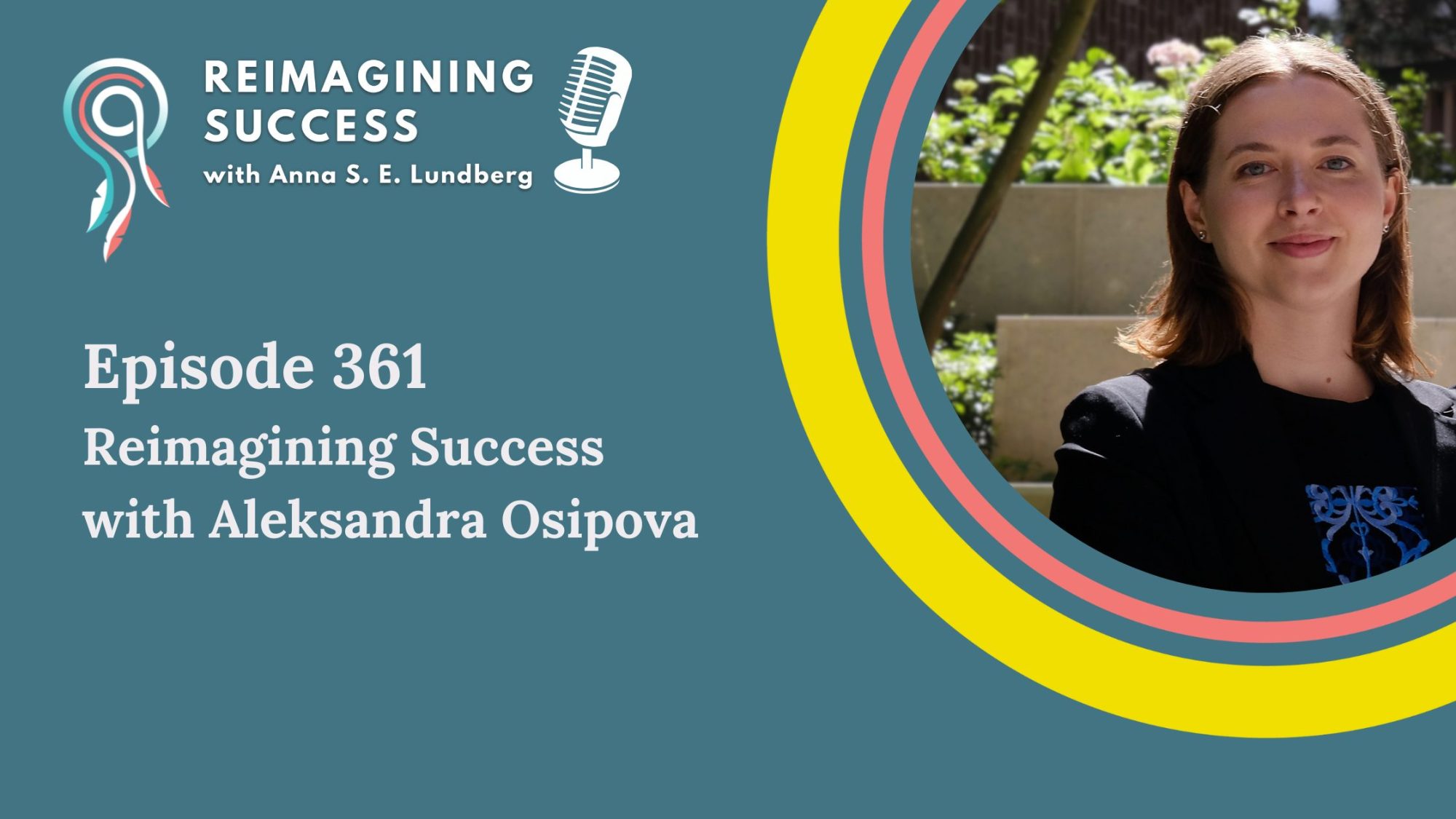


Ever wondered how you can create a sustainable business in a world obsessed with relentless productivity? In this powerful interview, Anna Lundberg sits down with AI strategist and Apricity Lab founder Aleksandra Osipova to unpack the journey from burnout to building an enterprise anchored in alignment, resourcefulness, and genuine human connection. Tune in to discover refreshing perspectives and practical advice for building a business you truly love – one that supports your wellbeing as much as your ambitions.
Key moments:
[00:00] Introduction and episode summary
[01:15] Aleksandra’s background: From applied mathematics to AI startups
[03:39] Career motivations and early interest in AI
[05:05] How Aleksandra’s definition of success evolved over time
[07:23] Avoiding burnout and shifting towards resourcefulness and connection
[09:12] The power of alignment over relentless goal-chasing
[13:07] Aleksandra’s new venture: AI automations for underrepresented founders
[14:49] Experimenting with AI and building custom solutions for solopreneurs
[17:10] Building a personal brand with authenticity and consistency
[18:49] Sneak peek into Aleksandra’s forthcoming book on critical thinking
[21:17] Day-to-day routines, wellbeing habits, and the return to ballet
[24:01] Advice for solopreneurs: Practise with AI, seek like-minded innovators, avoid information overwhelm
[25:28] Where to follow Aleksandra online
Resources mentioned:
- Aleksandra’s website: Apricity Lab
- Aleksandra’s upcoming book: Thoughtful: How to Think, Work, and Live in the Age of AI
- The Business Accelerator: OneStepOutside.com/accelerate.
- Connect with Anna Lundberg: Get in touch on Instagram or LinkedIn.
1:1 Coaching & Mentoring
For experienced founders and independents who want a trusted thinking partner – not a programme or a group, but direct, personalised work at the level you’re actually operating at. Anna works with a very small number of clients at any one time.
AI strategist
Anna Lundberg:
In this interview episode, we’re exploring what it really takes to build a meaningful, sustainable business in a world that is obsessed with speed and scale. Aleksandra Osipova, AI strategist, founder and former data scientist, shares her journey from burnout and relentless productivity to designing work around alignment, resourcefulness and genuine human connection. It’s a powerful reminder that success isn’t just about doing more. It’s rather about focusing on the work that matters, building relationships that energise you, and creating a business that supports the life you actually want.
Welcome to Reimagining Success, the podcast that helps you build a profitable business as an independent expert, one that works for you and your lifestyle. I’m your host, Anna Lundberg, former corporate insider turned business mentor, executive coach and mom of two. Whether you’re a solopreneur, a coach, speaker, consultant, I’m here to guide you in creating a business that gives you freedom, flexibility and the fulfilment you’re looking for, ready to redefine success and build a business that you love. Let’s get started.Okay. Hello, everybody, and welcome to this month’s interview.
Okay. Hello, everybody, and welcome to this month’s interview. And I’m here with Aleksandra Osipova.
And Aleksandra, I’d like to, as ever, hand straight over to you and tell us very briefly, I suppose, a little bit about your journey and then we’ll dig in in a moment. So what do you do and how have you got there?
Aleksandra Osipova:
Hi, I am founder of Apricity Lab and I’m an AI strategist. My journey to this point was quite long, starting from Applied Mathematics and Research and Academy and a couple of startups along the way, then work as a data scientist, as AI product manager. All in all, it was very fruitful journey in AI and I’m quite happy with what I’m doing right now.
Anna Lundberg:
Amazing. So, obviously it’s a pretty hot topic now, but back when you started in this field, was it something you were always passionate about? What led you to make the initial career decisions to get into this world?
Aleksandra Osipova:
I loved mathematics. And at that time, AI was called intellectual systems or complex models, or we didn’t speak about it as AI. And when I started my master degree and I told my supervisor that I want to do a project in AI, he said, do you mean statistical learning? And I said, yes, exactly this. And it was pure mathematics. And I was interested in the work of Alan Turing and his idea that a machine can construct the same machine. And once it’s possible, then we enter the point when we have artificial Intelligence. And I always loved reading books, always loved building complex models. And it turned out that what people call AI now you sound like my dad.
Anna Lundberg:
My dad said, oh, we used to do that long before it was called AI. We put new names on things, don’t we? But there you go. But that’s amazing that you started so early. So it sounds like that was then your interest in the subject matter that drove you. Was that always the driving factor when you were looking at what startup to join or what role to take on or how did you make your different career decisions within that field?
Aleksandra Osipova:
I. Well, when I founded my first startup it was about keeping track of medicine log and I had two passions, one was AI and another was building services that serving people. And then I gained another huge passion for neuroscience. And that was the reason why I exited my business in my home country and decided to move to the UK to do master degree. And I ended up doing a research project in studying epilepsy and data from the eeg. I learned a lot and I learned what it is to be a data scientist, surprisingly, without any support of the data scientist or the book about data science itself. I had two supervisors, one from one, one who’s mathematician and another who’s neurologist. And I just had data models, me, laptop, lots of coding, lots of coffee.
Aleksandra Osipova:
Yeah, I love that.
Anna Lundberg:
And would you say that your definition of success has changed from when you started coming out of university? And yes, I’m passionate about Alan Turing’s work and this is the field I want to get into versus where you are today. After your many startups and experiences, how has your definition of success shifted over those years?
Aleksandra Osipova:
At the beginning I didn’t think about success at all. It was all about being in the flow and doing stuff. And then once I enter entrepreneurship, I started to think about successes, amount of things that I can do per day. And it was crazy, crazy. Working hours every day a week. And everything was measured, everything was written. And then I started to think I was more about the mission and the value of things that I’m building. But I always measure that in terms of deliverables to be happy that I’m doing well.
Aleksandra Osipova:
And now I’m measuring success in terms of my resourcefulness and amount of connections that I can build, an amount of things that I can help other people to deliver with things that I’m building.
Anna Lundberg:
Can you tell me more? I love that definition. It’s a very nuanced one. So what does that mean in practical terms for you?
Aleksandra Osipova:
For me, as someone who burn out Quite a lot within the journey. It’s like every second year I would experience a burnout for one or another reason. And a couple of years ago it was a heavy state when I needed to stop everything, what I’m doing to recover. And in that moment it shifted for me that I need to take care of my sleep, my well being, my sports routine. So at that moment I started thinking about resourcefulness and about feeling connected to myself in the first place. And then, and then I noticed that the more you speak with people and the, the more genuine this connection is, it just fulfilled me more and more and I shifted from delivering information and knowledge to, to communicate and, and to learn about other people to what they do to be present and that, that is a current definition of success, though I’m not thinking about success, it’s more like the way of living.
Anna Lundberg:
Yeah, I love that. And especially funnily enough, in the world of AI, that kind of human connection is all the more important, right? And as you mentioned with burnout and so on. But a lot of us, if not all of us, get caught up in that kind of productivity, doing more, more, more, more, but being present and genuinely connecting human to human. I think, and maybe I’m wrong, but I think we can’t possibly burn out from that. I don’t know, correct me if I’m wrong, but I feel like I can’t late into night be like, oh my gosh, I’ve just got to humanly connect with another 20 people. That just makes it upside down. So I, I, I’d like to think, just thinking spontaneously, that that approach is such a great way to sort of slow things down, go for quality over quantity, get to know people, you know, not push for the sale right now, not go for all the automation software and so necessarily and not just churn out work, but really be a bit more thoughtful, a bit more present. But in doing so it becomes much more sustainable for you, for the business, and enjoyable as well. What do you think?
Aleksandra Osipova:
Yeah, absolutely. One more thing that is helpful in this journey is to stay aligned with what you really want to do. And this thing changed for me quite a lot because before I would set the goal and just walk through the doors and walls and nothing could stop me really. But it’s not the best approach. Now I feel that if someone really aligns with what I’m doing and they see the value, we instantly can match and do the project or do the business, but if not, it’s just a game of chasing and pursuing and it doesn’t resonate with me anymore. So alignment does help.
Anna Lundberg:
It’s such a cool word and I keep wanting to talk about alignments and it feels like quite a coachy word, but it captures so much. And I think you’re right that especially now, the world is so cluttered and AI and ChatGPT has a part to play there where we’re just kind of pumping out generic content and so there’s so many experts and everything and so on. Actually, again, the human connection and everything we’re talking about and, and not worrying so much about the, the sale and I don’t know what you’re saying with it. With alignment, it feels like it’s. It’s a nicer way to do it, but it’s also a much more effective way. What’s the point? And the analogy I was thinking about is dating. And I may have said this on the podcast before, but, you know, when you’re younger, I don’t know about you, but, you know, you kind of pretend to be cool, you. You like the same music as the other person or whatever, and then you. You don’t realise that actually if you keep doing that, if you do get married, let’s say with that person, you have to keep pretending to be someone else the rest of your life or they’ll be very disappointed when they realise that you’re totally different.
Anna Lundberg:
And I’m sure that happens many times and the same with clients. Now, if you’re building a business because that’s the business you think you should build, or if I’m, you know, if you, if we were having a sales call or a chemistry call and I sort of pretended to be aligned to your vision, I’m like, oh, yes, I am. You know, I’m the person to coach you because of XYZ reason. I’m persuading myself and you, that’s never going to be persuasive for you, I think. But also it’s not going to work ongoing and it’s going to make me unhappy and so on. Whereas actually, if you can take the pressure off, I don’t need to convince you here we have a conversation. It may lead to, in this case, a podcast interview. It may lead to working together or you recommend me to someone else, or it may not lead to anything and that’s absolutely fine.
Anna Lundberg:
Just taking the pressure off, whatever kind of business we’re running and looking for those genuine connections. I think it’s easy to say, of course, if we’re in a place where we desperately need money, it feels like Oh, I just want to sell something. But I think still even with that, if we can trust that the money will come, I guess if we can focus on those genuine connections, I think that’s both beautiful and a viable commercial strategy.
Aleksandra Osipova:
Yeah, absolutely. I heard very interesting statistics that we spent more time, three times more time and energy on sales that are not successful than the sales that are successful. And once I heard that, I had my life going like, okay, this meeting, this meeting, this meeting, this meeting. And it makes sense when you generally aligned and things happen instantly and if it’s not, you’re just thinking what do I do next? How do I do this and that. So I’m learning now that I’m building the business and it’s just a couple of months, it’s quite fresh and young business. I do need do more sales and try more things. But I keep this statistic in mind that if I feel it’s a no, then I better go.
Anna Lundberg:
Yeah, I think that again.
Anna Lundberg:
Yeah, there’s a subtlety there I suppose because there is a lot fortune is.
Anna Lundberg:
In the follow up they say and sometimes, you know, especially B2B decisions are made after the fifth, sixth call, whatever, but, but I mean a few weeks ago I had a call with someone, I’d never met her before. We had an immediate connection. She wanted exactly what I offered and she joined the accelerator the next day. She’d made the payment and it’s always like, oh, this is how it should be. It shouldn’t be checking in for five, six years. Hey, do you, you know, that just becomes exhausting for everybody. So yeah, I think that’s a really nice reminder. There is an important part of following up and nurturing and making sure that everyone’s ready.
Anna Lundberg:
But when it works, it really works, doesn’t it? But I’d love to hear about your business then. So it is quite fresh. But what is the business model at the moment? What are you working on? And yeah, tell us more about the picture and the vision for the next few years.
Aleksandra Osipova:
The vision for it is that I’m building AI automations and I’m building it for small and medium businesses with focus on people who are underrepresented in business. So I, I work quite a lot with female LED projects and, and some coaches and what I notice is that lacking AI in business is not really a problem. Like no one think, okay, I really need a tool or something, get the bait. It’s more, more about delivering the value and it’s quite interesting to see that solopreneurs. I, I’M a solopreneur right now that it’s possible to achieve much more with, in terms of, of, of the volume of what you can do and also in terms of things that you can delegate. And once you see that things are working, they’re working. And it gives lots of satisfaction to see that people don’t want to revert to the way they were before that. One part of the business, another.
Aleksandra Osipova:
I’m experimenting with lots of AI generated apps and as a product manager I know how to construct the application and I have almost an army of custom DPTs that are trained for everything you can imagine. I have a productivity coach, time management coach, like more like a therapist, business administrator, like it’s an architect developer. And I’m experimenting with what, what can be done with, with mixing different workflows and different style of chats.
Anna Lundberg:
Yeah, I’m doing the same, I’m sure far less advanced than, than you have. But it’s great to experiment, isn’t it?
Anna Lundberg:
And I guess there is a bit.
Anna Lundberg:
Of a backlash against, you know, there’s all this complaint around people using the so called ChatGPT. I don’t even know, is it em dash they call it. There’s sort of American grammar and so on.
Anna Lundberg:
But as you say as a solopreneur, my argument is, you know, what’s the difference between me hiring a copywriter versus using an AI tool or likewise creating images or the admin support and so on. But your point I guess about the goal for us as individuals in hiring you, let’s say, wouldn’t be like a company might go, oh, we must have AI, we’ve got to invest in AI. Whereas an individual, it’s more, oh, how can I get to this result faster, how can I sell, create more content, et cetera, et cetera. And then the way to do that is probably AI these days. It’s not that I’m going around saying, oh, I must get some AI, it’s really, it’s a means to an end.
Anna Lundberg:
And I think that’s an important thing to remember.
Aleksandra Osipova:
Yeah, absolutely. And I experiment quite a lot and I figure out that like I begin with AI Strategy session. It’s like Clarity session when I really don’t focus on AI, but I focus on what they want to achieve and it’s a strategy call, Clarity call. And again, I shifted from selling this strategy as a service when I built the maps presentation documentation to alignment with a person, with a team to where they want to go. Because strategy is a life documented. It’s Almost how you think, how you behave day to day. And it works much better. I see much better results within clients.
Anna Lundberg:
Yeah, I can imagine.
Anna Lundberg:
I think that’s for lots of us.
Anna Lundberg:
The business model of having a kind of diagnostic first before getting to work with them. So you’re bringing your expertise. Clearly, she knows what she’s talking about. She’s walking me through this process. And then if it’s not the right tool, then you can say that and they can go off and do something else. So I think that’s a really smart move in terms of the business model and positioning you as an expert and the right person then to work with. If we do find that the AI is the right answer, what about in terms of sort of the marketing side, building your personal brand? Obviously, we’re speaking. I know you’ve been working on your book, so tell us about how.
Anna Lundberg:
How are you building your personal brand at the moment?
Aleksandra Osipova:
Well, that’s. I. I’m bringing authenticity and I do what I really like to do. I love writing and I’m writing the blog about AI and I’m writing a lot on LinkedIn and I see how people respond to thoughtful questions or topics that are more personal. And I noticed that you never know who is reading. People might not react or something, but they would DM you and say, I would like to work with you or like, can we have a call? So that’s what I’m doing at the moment. And I will grow, sell brand on iterations. I don’t want to have a perfect idea and then wait lots of time until I gain all the resources to do that.
Aleksandra Osipova:
I will just do as I go. And about the book, I’m writing it and I’m very happy about what’s happening. Um, and the book is about critical thinking and initially it was about communication with chats and generative AI. But I figure out that critical thinking is the skill that we can apply everywhere with ourselves. With other people. With chats, it doesn’t really matter. And one of the key concept is leading with questions. What I notice a lot with generative AI with chats is it would normally reflect what you bring.
Aleksandra Osipova:
So if you bring the expertise, you can create great results. So what I see, for example, if you’re a product manager, then you can generate very good product materials. If you worked in the film industry, you can generate videos that are amazing. So I learned that generative AI is very good in upskilling whatever you do. And I’m writing the book about it. It’s coming soon.
Anna Lundberg:
Yes. And hopefully when this is out, the book might be out as well, so we’ll make sure to put the details if so. But critical thinking, my goodness. I just think it’s the thing we should be teaching insofar as it can be taught. It should be the focus of school curricula now, right? I mean from mathematics before, the whole process of moving to calculators was a similar shift, albeit not as dramatic perhaps as now. Suddenly you can go home and write your whole essay with an AI tool, you know, so the critical thinking is so powerful. And I spoke to a friend actually who’s, who’s working in a startup and he said slightly stereotypically, you know, this whole Gen Z thing. But he noticed that some of.
Anna Lundberg:
Some of the younger people in his team seem to be very easily persuaded by certain things that came out of social media, let’s say, oh, we were never on the moon or whatever it is and they haven’t yet, I suppose learned. And it is a difficult one for all of us to critically assess the massive onslaught of information we get. So I think that’s a very hot topic and very much needed. And I love that you found the angles. It’s not just how do you use AI for your business, but it’s really so much more powerful and with such longevity, I think, and so, so important whether you’re young or, or those of us who are a bit older and more. More experienced. I think that that’s such an exciting thing to be focusing on. So needed.
Aleksandra Osipova:
I write a book for people in their 20s or people figuring out how to learn how to create with tools that are available now. But also it’s a book for people who are transitioning into new ways of working. So it’s not age limited to anyone.
Anna Lundberg:
I’ll get a copy and give it to my friends for his team, definitely get some copies for him. So what does the day to day look like for you? I know you’ve mentioned that you’ve experienced burnout a few times time. So do you make sure that you have boundaries in place? How do you take care of yourself? You mentioned obviously sort of health and exercise. What does a typical day or a week look like for you?
Aleksandra Osipova:
I. I work with a flow so I don’t have a certain days when I work or don’t work like I, I work on Saturdays and Sundays most of the time I start at 5am, sometimes at 6. I would meditate, do some writing notes. Sometimes it’s a very creative time for me. So I would do the most of the Work and then I either would have a nap or like till. Till nine, till normal hours or go to the gym, go for a run. And then I’m just doing my daily stuff, balancing time I spent writing just with handwriting, with laptop, meeting people, connecting with people. And I also recently started in Bali, which is lots of fun.
Anna Lundberg:
Love that it’s so important to have, I mean first of all to. Yeah. To do something for ourselves, which I think is quite rare for women our age perhaps as well. But also. Yeah. Just to distract us from work. Right. If we only do work, it’s very easy to.
Anna Lundberg:
That becomes our full identity, especially when we’re passionate about it. We love what we do. So I love that, that. Oh, that’s very ambitious. I just shared with someone the other day that I used to obviously as a four year old, want to be a ballerina, but I’ve long since given that up. That’s, that’s not even on my bucket list anymore. But there are other things I could probably pursue a bit more. Oh, I love that.
Aleksandra Osipova:
That was my dream when I was 3, 3, 4 years old. And I become a mathematician instead. And now what, what I’m learning, it’s, it’s a, it’s a great thing to do. Like the, the, the whole body is working and also you learn coordination, you learn new words, new things.
Anna Lundberg:
And have you done it before or is it completely new to you?
Aleksandra Osipova:
No, that’s new.
Anna Lundberg:
So it’s not too late. I mean, yeah, I just wonder. My, my body is kind of locked into place. I never had flexibility even when I was younger, so I think now it’s too late for me.
Aleksandra Osipova:
I’ll send you the information.
Anna Lundberg:
There I was. I thought I was off the hook, but fine, it sounds like a good idea. I do a lot of running, so my muscles get really tense and actually elongating and stretching. You know, whether it’s Pilates or yoga or possibly ballet is probably a good idea. So thank you for that tip.
Anna Lundberg:
So to wrap up, I suppose, well, either a career tip, but really given.
Anna Lundberg:
That you’re working in such an exciting space. I mean, as we speak, obviously things are changing, but what advice or sort of wisdom or what maybe an insight from your book would you share with someone who’s kind of excited but a bit afraid maybe. Is AI going to take my job? What can I do to use AI? You know, speaking to the solopreneur, expert audience, the kind of people you work with. What would you say to someone at this?
Aleksandra Osipova:
If you want to learn about AI, you learn you learn the skills by practising. So if you’re watching lots of YouTube videos or reading about stuff, about trends, my experience is that I got overwhelmed by all the news. But if I practise and for example, there’s a new tool, new approach, new prompt, I would just sit down for an hour and play with it and see what’s the outcome. How can I link this knowledge to anything else? How can I apply it? The advice is to start practising, maybe create a focus, time, hour for AI to try it, and speak with people who are building. Not with, like, not. Don’t hang out with people who are very sceptical about AI. I know everything about risk and about addicts and I love this kind of conversation as well. But I spend a lot of time with people who are building something because it just create the momentum and energy.
Anna Lundberg:
Effy? Yeah, I’d love that advice. I mean, I always think if you want to write a book, spend time with people who are writing books, right? It suddenly becomes a natural thing. If you want to do ballet, obviously spend time with people doing ballet. And if you. If you want to, yeah, advance in technology, then find people who are doing exciting things there and get inspired rather than staying with those sceptics. I think that’s a great piece of advice. So, Aleksandra, hopefully, as I said, I will link the book once that’s available, but in the meantime, where can we find you and read more about the work that you’re doing?
Aleksandra Osipova:
I’m on LinkedIn. I’m on Substack. On Substack, I have two blogs, one about specialty copy and embodiment, one about AI and Apprecitylab. Co is the website of my business. So, yeah, I. You. You can find me by. By Googling my name.
Anna Lundberg:
We’ll find you. Yeah, you’re lucky. I’ve got. I’ve got a problem. We can talk about that offline and ask everyone for advice. My name is so common in Sweden, but also there’s a famous actress now who had a baby with another famous actor and she’s taken over my online presence. So I. I very much need to work on my.
Anna Lundberg:
My PR strategy, unfortunately. But I’m very jealous of you with a more unique name. Thank you, Aleksandra. Thank you so much. It’s been so lovely to speak to you. Such a thoughtful assessment, I guess, if I can call it that, of your own journey and some really good advice there as well. So thank you so much. Best of luck with the next stage of your journey and looking forward to staying in touch.
Aleksandra Osipova:
I really appreciate the conversation with you and I love what you’re writing on your LinkedIn. I really feel seen when I read your posts and it’s quite rare when you read the post and you’re doing or like what you’re going through. So I’m very grateful to stay connected.
Anna Lundberg:
Oh, thank you. That means a lot. It’s always nice to know that people are reading and it’s not just going out into the ether. So thank you so much. I appreciate that.
If you’re ready to grow a business that actually works, one that pays you well, protects you your time, and reflects what matters most the Business Accelerator is for you. It’s a 12-month journey for independent experts who want strategic growth without burnout and without compromise. Apply or join the waitlist at onestepoutside.com/accelerate.
WORK WITH ANNA
Let us help you design a business and a life that gives you freedom from the 9 to 5. There are several options for how you can work with us. Choose the programme that’s right for you.
The Outsiders Business Accelerator
A mastermind for service-based business owners, freelancers and online entrepreneurs who are ready to achieve success on their own terms. onestepoutside.com/accelerate
1:1 Coaching & Mentoring
If you’re looking for one-to-one support to help you achieve your specific life and business goals, Anna has a limited number of spots for individual coaching and mentoring. onestepoutside.com/coaching
Off Script community
A community for established independents who’ve chosen their own definition of success and want a room of people who’ve made the same choice.


